Interview with Guillaume Haldimann
Can you introduce yourself and tell us about your cycling journey?
My name is Guillaume Haldimann, I am 23 years old, and I live in Switzerland. I currently race at the National Elite level for Team Humard VP while pursuing my HEC business degree at university. Cycling has been my passion since childhood—I raced my first mountain bike event at age 6 and explored almost every discipline over the years (XCO, XCM, Enduro, Downhill, Cyclocross, and Road).
Until 2023, my main focus was XCO, using road races primarily for training. However, I found myself enjoying road racing more and more, so in 2024 I made the full transition to road. The immediate success at the National Elite level motivated me to take every single aspect of performance to the next level.

Photo Credit: Tour de Guadeloupe
You are currently balancing studying at university, training, elite racing, and working as a bike mechanic. How do you manage to do all of this?
I rely heavily on structure, routine, and automation for both my training and studies. My repair workshop doesn't generate constant daily volume; client requests are project-based, allowing me to plan maintenance slots flexibly around my riding.
I often prioritize tasks based on ROI (Return on Investment)—especially with studying, where it is very easy to get lost focusing on too many minor details. I set clear deadlines and focus on daily consistency: doing something every day, even when motivation is low. Learning to say 'no' to social invitations when major deadlines approach is probably the hardest part, but it's essential.
Above all, my university's dedicated sports-study program makes this lifestyle viable. Being able to follow lectures remotely from home with an adapted 4-year bachelor curriculum eliminates daily campus commutes and frees up the time required for elite training and mechanics.

Photo Credit: Tour de Guadeloupe
You managed to get second overall at the Tour of Albania. You also won a stage and got second in another. What were the biggest challenges you faced during the race?
The course in Albania suited my characteristics very well with fast, rolling stages. The real tactical challenge began once I took the Yellow Jersey. As a smaller team with primarily climber/puncher teammates, we didn't have the horsepower to control the entire peloton on flat terrain with small time gaps.
In the final of stage 4, I found myself isolated and couldn't cover every single move. After multiple attacks, a rider managed to go solo with 3 km to go; I tried to limit the gap, but ultimately lost the overall GC by just 10 seconds due to bonus seconds. It was a tough tactical lesson, but a great learning experience.
You recently raced in the Tour de Guadeloupe, getting second on stage How did the race compare to the Tour of Albania?
The overall level was higher, and the terrain was significantly more demanding—featuring punchy, steep gradients even on nominally flat stages. Guadeloupe presented a unique combination of challenges: 10 intense racing days, time zone adaptation, extreme humidity, and high heat. I unfortunately caught a cold and sore throat two days before the start, which I had to manage throughout the entire tour.
Heat and nutrition were the hardest factors. With extreme sweating, hydration was critical. Being abroad with limited feed zone support, I started every stage carrying three bidons (one under my jersey) and constantly tried to maintain that buffer. Racing 10 consecutive days was a first for me, and by the second half, flavor fatigue set in with sports drinks and gels—even post-race pasta and rice became tough to swallow! Luckily, local fresh fruit juices were a lifesaver for easy carb intake.
The roadside atmosphere was unforgettable. The passion and sheer volume of spectators calling out my name when I was in breakaways was something I had never experienced before. While I fell short of my initial targets (a stage win and Top 10 GC)—missing the Stage 4 win by less than a tire width and losing GC contention after a Stage 6 crash broke my bike—it gave me the freedom to race aggressively on the attack every day in the second half.

Photo Credit: Tour de Guadeloupe
As a professional bike mechanic and one of the top UCI Club riders, what do you look for when choosing a race wheelset?
Racing internationally has evolved my perspective on wheels. While Swiss roads are pristine, roads abroad are often much rougher. Wider tires clearly provide superior rolling resistance, comfort, grip, and puncture protection on rough tarmac. Therefore, I prioritize rims with generous internal and external widths to optimize 30–32c tires aerodynamically without creating an abrupt tire-to-rim transition.
From a mechanic's viewpoint, hub reliability and serviceability are something i look closely—I strongly favor ratchet systems for their simplicity and robustness. Finally, the stiffness-to-weight ratio is crucial. Being a taller, high-power rider, I look for a wheelset that delivers high lateral stiffness and razor-sharp handling, while still valuing the agile, responsive feel of a lightweight setup.

Photo Credit: Guillaume Haldimann
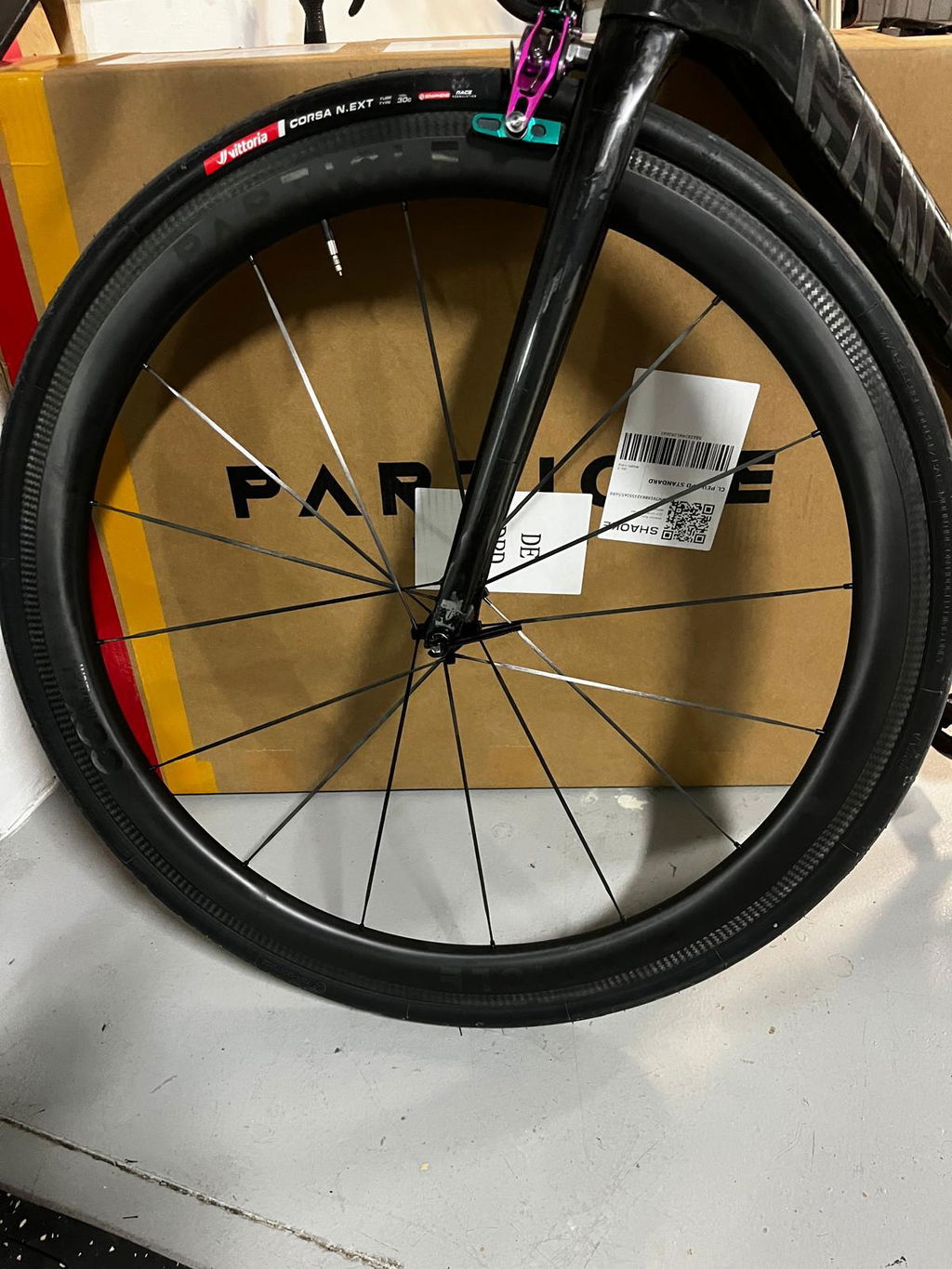
You ride both GCX45 Hyperlight and GCX60 Light wheelsets. Have you raced with them? How do you choose which one to use and how do they compare to your DT Swiss ARC 1100 (65mm) you were riding before?
I raced extensively on the GCX60 during the Tour de Guadeloupe. With the GCX45 Hyperlight, my bike actually dropped significantly below the 6.8 kg UCI minimum weight limit, so I didn't want to risk any regulatory issues at a UCI event! I plan to use the GCX45s for national mountain stages and late-season hill climbs.
As a rouleur, I opt for deep-section wheels like the GCX60 about 90% of the time because my strength lies in fast, rolling terrain and long breakaways spent fighting the wind. I reserve the GCX45 for high-elevation profiles or stages where a breakaway isn't an option and saving weight on climbs takes priority.
Compared to my previous DT Swiss ARC 1100 (65mm), the first noticeable advantages of the Particle wheels are the lower rotational weight (delivering sharper acceleration) and dramatically improved crosswind stability. The GCX60 matches the high lateral stiffness of the DT Swiss, while the GCX45 offers a slightly more compliant ride—reminiscent of the Campagnolo Hyperon Ultra in terms of feel. Steel spokes naturally offer a bit more vibration damping, whereas the carbon spokes on the GCX series provide exceptional front-end stiffness and precision when diving into corners.

Photo Credit: Guillaume Haldimann
How did you become a self-taught bicycle mechanic? Can you tell us about your shop?
My journey into mechanics happened organically. Whenever an issue arose on my own bike, I made it a point to diagnose and fix it myself. My father has solid mechanical knowledge, and having experienced mechanic friends provided great guidance alongside watching countless technical tutorials and bike build videos on YouTube.
Once I began assembling and servicing my own race bikes from the frame up, riding friends started reaching out for repairs. That inspired me to officially launch GH Bike Services, operating an independent workshop focused exclusively on maintenance, diagnostics, and repairs.
What are your goals for the next few race seasons? Do you have aspirations to join a pro cycling team?
While my exact race calendar for upcoming seasons is still unknown, there is one race where I really want to shine—and where I’ve had some bad luck in recent years: the Swiss National Championships.
My main focus is continuous physical and tactical development to consistently contest race wins, all while making sure to keep it fun; I truly enjoyed racing this season, and the results followed naturally. My ambition is definitely to step up to the professional peloton, ideally starting next season if the right opportunity arises.

Photo Credit: Tour de Guadeloupe
What advice would you give young riders who want to reach an elite level?
First, consistency and coaching trust. One of my greatest strengths is rarely missing a scheduled session; steady accumulation of work is the foundation.
However, when raw linear progress naturally plateaus, the hardest skill becomes learning to listen to your body. Early on, I fell into the 'no pain, no gain' trap, always saying I felt fine and wanting to do more. But a coach cannot guess what you feel, and relying solely on data is not enough. Constantly doing a bit too much can kill your gains—remember that your body actually adapts and progresses during recovery periods. You must develop intuitive awareness of what works for your training, recovery, sleep, and nutrition; even evidence-based science has individual limits.
Second, mindset: cycling is a sport where you lose far more often than you win, and your race results do not define your worth as a person. Respect your body, your mind, and your time. It’s not 'you against you', it's you with you. You shouldn't feel overwhelmed by pre-race pressure; if you do, talk openly to someone about it.
Finally, protect your superpowers. While patching major weaknesses is necessary, never do so at the expense of your signature strengths. To win at the highest level, you must be truly exceptional at something.