The Definitive Guide to Carbon Road Wheels: Engineering, Aerodynamics, and Performance Excellence
Understanding the Impact of Aerodynamic Wheels on Speed and Wind Interaction: Aluminum Wheel to a Carbon Wheel
The modern cycling landscape is defined by a relentless pursuit of speed, and for most riders, the single most transformative upgrade available is a high-performance carbon wheelset. Transitioning from traditional aluminum wheels to carbon road wheels represents more than just a reduction in weight; it is a fundamental shift in how a bicycle interacts with the wind, the pavement, and the rider's power output. As we move through 2026, the technology behind the carbon rim has matured into a sophisticated science of composite layups, resin chemistry, and computational fluid dynamics. Whether you are a dedicated racer seeking every aerodynamic advantage or an enthusiast looking for the best endurance riding carbon wheels, understanding the mechanical metrics of your wheelset is essential for making an informed investment.
Material Science: The Structural Superiority of Carbon Wheels
Comparing Carbon Road Wheels and Aluminum Rims
The debate between a carbon wheel and an aluminum wheel often begins with weight, but the structural differences run much deeper. Aluminum rims are typically manufactured through extrusion or forging, processes that result in a balanced but ultimately limited strength-to-weight ratio. In contrast, a carbon rim is constructed from layers of carbon fiber sheets, often utilizing a unidirectional (UD) layup pattern that allows engineers to place material exactly where it is needed most to handle specific stress loads. This material efficiency is why carbon wheels can be significantly lighter while maintaining superior lateral stiffness. While a standard aluminum wheel may weigh approximately 1,000 grams on its own, an ultralight carbon rim can weigh less than half of that, even at much greater depths.
How Composite Layups and Resin Define the Modern Carbon Road Wheel
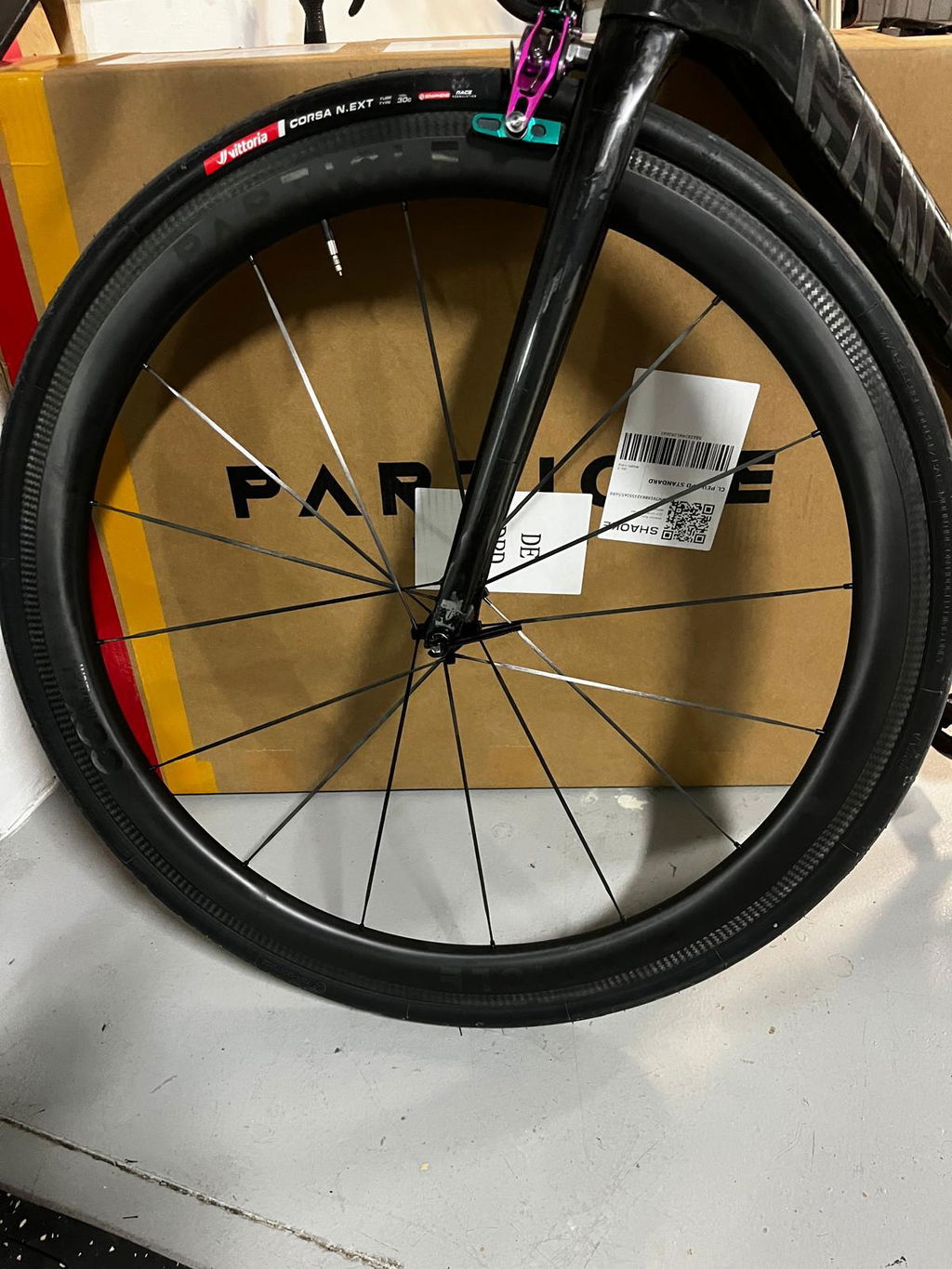
The performance of a carbon wheelset is largely determined by the grade of carbon fiber used, such as Toray T700 and T800, which Particle utilizes to balance durability with lightweight compliance. While higher modulus fibers like T1000 exist, they can often lead to a more fragile rim; by sticking to optimized T700 and T800 layups, engineers ensure that carbon rims are resilient enough for everyday abuse while remaining incredibly responsive. Furthermore, modern resin systems, such as the 220°C high-temperature resin found in specialized series, are critical for rim brake applications where heat management is paramount. This engineering focus prevents the structural failures often associated with early-generation carbon fiber wheels.
How a Carbon Fibre Wheelset Eliminates the Power Loss and Flex of an Aluminum Wheel
One of the primary reasons carbon wheels are so highly regarded by riders is their exceptional lateral stiffness. When you stand out of the saddle to sprint or climb, a stiff wheelset ensures that every watt of power is transferred directly into forward momentum rather than being lost to wheel flex. Particle's Team series, for instance, is specifically engineered to be up to 18% stiffer than the
Ultralight variants, catering to high-wattage sprinters who demand absolute rigidity. This stiffness also translates to more precise cornering, as the carbon wheel tracks more accurately through high-speed turns.
Aerodynamics: Maximizing Your Aero Advantage
The Relationship Between Rim Depth and Speed: Shallow Rims vs Deep Section Rims
For the average rider, aerodynamics is the primary force resisting forward motion once speeds exceed 30 km/h. The rim depth of a wheelset is the most significant factor in its aerodynamic efficiency. Shallow rims, generally between 20mm and 35mm, are often prized as climbing wheels due to their low rotational weight. However, they offer minimal aerodynamic gains on flat terrain. Deep section wheelsets, typically 60mm or deeper, are designed to keep airflow attached to the rim surface for as long as possible, reducing the size of the wake and the resulting drag. In a time trial or flat-stage scenario, the aero advantage of a deep carbon aero wheel is unmistakable.
The 105% Rule and Crosswind Stability
A critical concept in modern aerodynamic wheel design is the "Rule of 105," which states that the external rim width should be at least 105% of the tire width to optimize aerodynamic gains. This ratio ensures that the airflow transitions smoothly from the tire onto the carbon rim without creating excessive turbulence at the leading edge. Particle applies this philosophy across its RCX and GCX series, using U-shaped and toroidal profiles that help the air reattach even at high yaw angles. These rounded profiles also provide significantly better stability in crosswinds, preventing the "snatching" sensation that often plagues V-shaped deep section wheels.
Computational Fluid Dynamics and Real-World Yaw
Efficient aerodynamics is not just about performance in a headwind; it is about how carbon wheels handle the varying yaw angles of real-world riding. Advanced modeling and laboratory testing allow engineers to create rim shapes that actually generate a "sailing effect" at certain wind angles, effectively pushing the rider forward. The Ultralight series from Particle exemplifies this, providing raw aerodynamic gains that allow riders to maintain higher cruising speeds with less effort. By optimizing the rim depth and profile for 28c or 30c tires, these carbon rims maintain a smooth aerodynamic profile that riders can rely on in all weather conditions.
Rim Width and Tire Interface Dynamics
Carbon Rim: The Shift to Wide Internal Widths
In recent years, there has been a massive shift toward wider internal rim width in the world of carbon wheels. Older carbon fiber wheels often featured narrow 15mm to 17mm internal channels, which forced tires into a "lightbulb" shape that was both aerodynamically inefficient and prone to squirming under cornering loads. Modern carbon rims from brands like Particle utilize 19 - 25mm internal widths that allow tubeless and clinchers to sit more naturally. This increased width expands the tire's volume, creating a wider and shorter contact patch that reduces rolling resistance and improves mechanical grip.
Optimizing the Tire Footprint
A wider rim width doesn't just improve speed; it fundamentally changes the ride quality. By supporting the tire's sidewalls more effectively, a wider carbon wheel allows riders to run lower tire pressures without the risk of the tire folding during aggressive cornering. This is particularly beneficial when using a tubeless tire, where the lack of an inner tube allows the tire to deform more easily over road imperfections. The result is a wheelset that feels incredibly smooth and planted, even on rough chip-seal or light gravel surfaces.
Carbon Wheel: Hooked vs. Hookless Rim Design
When choosing a carbon wheel, riders must decide between hooked and hookless rim profiles. Hookless rims are often lighter and easier to manufacture, but they impose strict limitations on tire pressure—usually a maximum of 72.5 PSI—and are only compatible with specific tubeless tires. For many riders who prefer the security of high-pressure clincher tires or the versatility of different tire brands, hooked carbon fiber rims remain the gold standard. Particle exclusively uses hooked profiles for its road and gravel carbon wheels to ensure maximum tire compatibility and rider safety, especially when descending at high speeds.
The Mechanics of Hubs and Power Delivery
The hub is the heart of any wheelset, and its design dictates how efficiently power is transferred from the drivetrain to the road. Traditional pawl hubs rely on small spring-loaded "teeth" that engage a ring, but modern high-end carbon road wheels are increasingly moving toward star ratchet systems. Particle's SR1 and AR1 hubs utilize this star ratchet design, machined to incredibly tight tolerances of 0.005mm. This precision ensures that the ratchets engage simultaneously across a larger surface area, providing more reliable power transfer and a longer lifespan than traditional designs.
Ceramic vs. Steel Bearings
When choosing a high-performance hub, the debate between steel and ceramic bearings always comes up. While ceramic is often marketed as the ultimate upgrade, the reality is that high-grade steel remains the benchmark for real-world durability. Out of the box, ceramic bearings offer a fractional performance gain, but they don't have the same long-term lifespan as their steel counterparts. For most riders, premium steel is the more reliable, cost-effective choice.
However, we know many riders simply want the absolute highest-tier option available—and we also understand that mentality. That is why Particle offers both steel and ceramic bearing choices across our AR1 and SR1 hubs, giving you the freedom to choose between maximum longevity or chasing every last marginal gain.
Hub Geometry and Bearing Longevity
Beyond the bearings themselves, the geometry of the hub shell plays a vital role in how carbon wheels perform over time. A hub shell that is not machined to perfect tolerances can put uneven stress on the bearings, leading to premature wear and increased rolling resistance. By using aerospace-grade aluminum, modern hubs protect the internal mechanisms from the elements, ensuring that your carbon road wheel remains smooth and fast for thousands of kilometers.
Traditional Steel Spoke Reliability
For decades, the steel spoke has been the backbone of every bicycle wheelset. Steel is a highly mature technology, offering predictable fatigue life and a degree of vibration damping that many riders appreciate. High-quality bladed steel spokes provide a decent aero advantage while remaining easy to service. However, steel is fundamentally limited by its weight; even the lightest steel spokes are significantly heavier than their carbon counterparts used in modern carbon wheelsets.
The Breakthrough of 4th Generation Carbon Spokes
Carbon spokes are no longer the fragile, bonded-in experiments of the past. The 4th generation carbon spokes used by Particle represent a massive leap forward in wheel technology. Unlike early versions that were glued into place, these spokes are mechanically secured and fully replaceable, just like steel spokes. Weighing only 2.1 grams each, they are more than 50% lighter than the best steel spokes. Furthermore, they are significantly stiffer, allowing for a wheelset with incredible responsiveness and power transfer.
A common misconception is that carbon spokes make for a harsh, uncomfortable ride. While early carbon spoke designs were indeed very stiff, Particle's 4th generation spokes are engineered with a specific profile and titanium interfaces that provide a ride feel more akin to steel. This allows a carbon wheel to be both laterally stiff for sprinting and vertically compliant for long-distance comfort. When paired with the 21mm or 25mm internal rim width of modern carbon rims, these spokes create a wheelset that is exceptionally fast without being punishing.
Tire Choice: Tubeless, Clincher, and Tubular Dynamics
In 2026, tubeless tires have become the standard for professional racing and high-performance training alike. By eliminating the inner tube, tubeless systems reduce internal friction, leading to lower rolling resistance and improved aerodynamic efficiency. They also allow riders to run lower pressures for increased grip and comfort without the fear of pinch flats. All of Particle’s carbon wheels are designed with a tubeless-ready hooked interface, making them the perfect carbon wheels for those who want the latest in puncture protection and speed.
The Practicality of Clincher Tires
Despite the rise of tubeless, clincher tires remain incredibly popular due to their simplicity and ease of maintenance. For many riders, the ability to quickly swap a tube on the roadside without dealing with sealant is a major advantage. Modern TPU and latex inner tubes have also closed the rolling resistance gap, making clincher tires a viable high-performance option. Because Particle’s carbon rims feature a hooked design, they are fully compatible with any standard clincher tire, providing the ultimate versatility for a carbon road wheel.
The Legacy of Tubular
While tubular tires were once the undisputed choice for pro racers, they have largely been superseded by tubeless technology in recent years. A tubular tire offers a unique, supple ride quality and is exceptionally light, which is why some purists still choose them for climbing. However, the difficulty of installation and the impossibility of roadside repair make them less practical for the average consumer. In response, Particle has focused on making their clincher and tubeless carbon road wheels as light or lighter than traditional tubular setups.
Specialized Performance: Hyperlight and Ultralight Series
The Hyperlight Series: The Ultimate Climbing Wheels
For riders who live in the mountains, the Hyperlight series represents the pinnacle of carbon wheel technology. The
RCX27 Hyperlight is one of the lightest UCI-approved carbon road wheels ever made, weighing in at a staggering 835 grams for the complete wheelset. This is achieved through a cutting-edge carbon layup and the use of the SR1 hubset, which is optimized for minimal weight. When every gram matters on a 10% gradient, the low rotational inertia of these carbon wheels provides a tangible performance benefit that aluminum wheels simply cannot match.
The Ultralight Series: Balancing Aero and Weight
The Ultralight series is designed for riders who want a versatile wheelset that excels on both flats and climbs. These carbon wheels feature mid-depth rim profiles—typically between 40mm and 55mm—that offer significant aerodynamic gains without a major weight penalty. The RCX50 Ultralight, for example, weighs just 1,055 grams, making it lighter than many dedicated climbing rims from other brands. This series is the weapon of choice for our sponsored pro teams racing on the WorldTour, where sustained rolling speed and crosswind stability are pivotal to consistently performing and challenging at this level.
The Role of the Team Series
While the Hyperlight and Ultralight series focus on extreme performance, the Team series provides a robust, high-value option for riders who prioritize lateral stiffness and a higher weight limit. These carbon road wheels are engineered to withstand up to 140kg of total system weight, making them the best carbon wheels for larger riders or those who carry gear on long-distance tours. Despite their beefier construction, they still feature Particle’s signature carbon spoke technology and precision hubs, ensuring a high-performance experience.
Safety, Testing, and Long-Term Reliability
Safety is a non-negotiable aspect of carbon wheel design. While the UCI Vertical Impact Test requires wheels to survive a 40-joule impact, Particle’s internal standards are much more rigorous. Every carbon road wheel in their lineup is engineered to survive impacts of 90 joules or more—twice the industry standard. This ensures that whether you hit a pothole during a race or a sharp rock on a gravel detour, your carbon wheels will maintain their structural integrity.
Quality Control and Laboratory Metrics
Behind every Particle carbon wheelset is a strict quality control process that begins at the fiber level. Rims are weighed at every stage of production, and every spoke hole is inspected for resin buildup or structural wrinkles. Before shipping, every wheelset is stress-relieved and re-trued to within a lateral and radial runout of 0.25mm. This level of precision is what separates a world-class carbon wheel from a generic open-mold product.
Warranty and Crash Replacement Policies
Investing in a carbon wheel is a significant commitment, and road riders deserve peace of mind. Particle offers a comprehensive 3-year warranty that covers defects in rims, hubs, and spokes. Furthermore, they provide a lifetime crash replacement policy, offering a 25% discount on replacement parts regardless of how the damage occurred. This commitment to customer service ensures that your carbon road wheel is a long-term performance partner rather than a risky one-off purchase.
Sustainability and the Future of Carbon Wheels
Carbon Fiber: Reducing the Environmental Footprint
As the cycling industry grows, the environmental impact of manufacturing carbon fiber has come under scrutiny. Particle is leading the way by using biodegradable release agents in their molds and opting for a "raw" unidirectional finish that eliminates the need for heavy, waste-generating paints. Furthermore, they utilize laser engraved decals, which save weight and reduce the use of plastic and chemicals found in traditional water-slide decals on carbon fiber wheels.
The Repairability Revolution
One of the most sustainable things a brand can do is make products that last. By moving away from bonded-spoke designs and embracing replaceable 4th generation carbon spokes and easily serviceable star ratchet hubs, Particle ensures that their carbon wheels don't end up in a landfill after a single broken part. This "repair, don't replace" philosophy is a core part of their design language for 2026 and beyond.
Social Responsibility and Giving Back
Performance is a great goal, but Particle believes in a greater purpose. They donate 10% of their profits to World Bicycle Relief, an organization that has provided nearly a million bicycles to people in need around the globe. For road riders, this means that every time they choose a Particle carbon road wheel, they are also helping to make cycling more accessible to someone else.
Conclusion: Making Your Final Wheelset Choice
Choosing the right carbon road wheel involves balancing your specific riding goals with the technical realities of rim depth, rim width, and spoke technology. If you are a dedicated climber chasing KOMs, a shallow rim from the Hyperlight series will provide the lightweight responsiveness you need. For those who spend their time in fast group rides or local criteriums, the aero advantage and sustained speed of a mid-to-deep section Ultralight wheelset are unbeatable aero wheels.
Regardless of which model you choose, the transition to a modern carbon wheelset is a revelation in speed, handling, and comfort. By focusing on precision engineering, wide internal rim width, and revolutionary carbon spokes, brands like Particle are ensuring that the road riders of 2026 have access to pro-level performance at a reasonable price. Your wheelset is the most critical link between you and the road—make sure it’s a carbon wheel that is built to perform, built to last, and built to inspire your next ride.