How to Choose the Right Road Bike Tire Width
Road bike tire width used to be a small detail, but in 2026, it is the defining factor of your road riding experience.
Choosing the right tire sizes can change how a road bike feels almost as much as the frame geometry or the material of the wheelset.
The modern consensus has moved away from the rock-hard, narrow tires of the past toward wider tires that prioritize speed through efficiency rather than just high pressure. This guide will help you navigate the technical nuances of the width of tires to find the perfect setup for your goals.

The Evolution of Tire Widths in Road Cycling
For decades, the standard for a performance road bike was a 23mm tire inflated to well over 100 PSI. The logic was simple: less rubber on the road and higher pressure meant less rolling resistance.
However, modern research into cycling mechanics has debunked this. On real world roads, which are rarely perfectly smooth, narrow tires at high pressures actually cause suspension losses. Instead of absorbing imperfections, the bike bounces over them, wasting energy that should be moving you forward.
By choosing wider tires, you allow for a larger air volume and lower pressure. This allows the tire to deform over the road surface rather than being deflected by it.
At Particle, we utilize Rider-First Engineering to ensure that our RCX and GCX Series carbon wheels are not just light, but structured to handle the specific loads of these modern high-volume setups.
How to Choose the Right Road Bike Tire Width for Your Style
The primary question is no longer "is wider better?" but rather "how wide for my specific purpose?" Most road tyres today fall into three categories:
25mm to 28mm: The Traditional Speed Setup
These tire sizes still have a place for riders who prefer a firmer ride feel or those using legacy frames with limited tire clearance.
If you are racing on perfectly smooth tarmac or using a rim brake wheel like our CCX Ultralight, a 25mm or 28mm tire is often the maximum width the calipers can accommodate.
Most of Particle's RCX Series' are specifically aero-optimized for 28c tires, ensuring that the aerodynamics of the wheel and tire system remain cohesive.
30mm to 32mm: The Modern All-Arounder
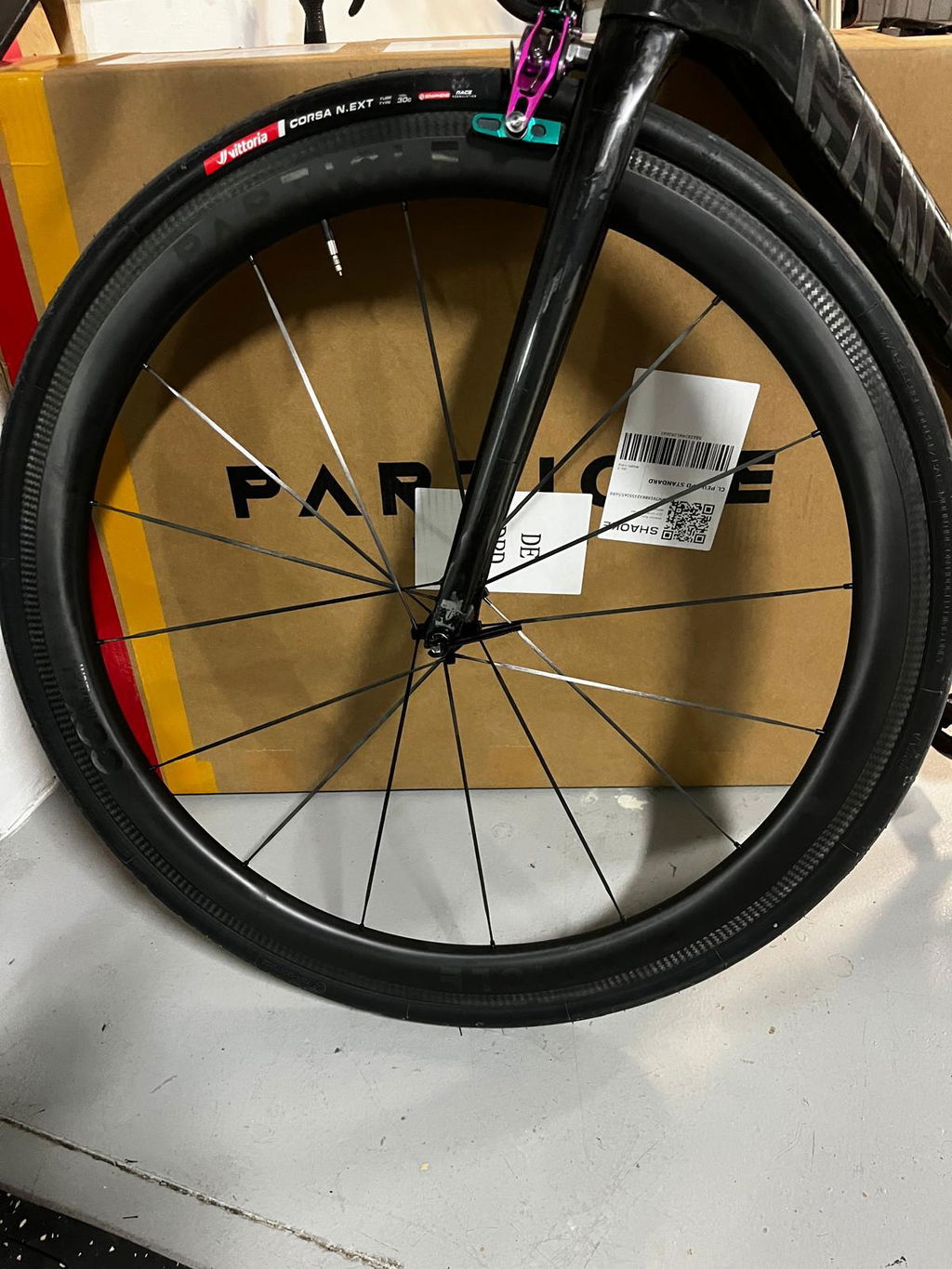
For most cyclists, this is the current "sweet spot." A 30mm tire on a road bike balances speed, comfort, and grip in corners.
This width allows you to drop your pressure significantly, reducing fatigue over long hours in the saddle. On roads with cracked pavement or chip-seal, this setup is often objectively faster because it eliminates the speed penalty caused by vibration.
34mm and Wider: Endurance and Gravel Bike
Once you move past 34mm, you are entering the territory of all-road and light gravel bike use. These wide tires are ideal for riders who prioritize comfort over razor-sharp acceleration.
To support these higher volumes without the tire taking on an unstable "lightbulb" shape, you need a wider rim. The Particle GCX Series features a 25mm inner width, which is aerodynamically optimized for 30c to 32c tires but can safely accommodate gravel bike tires up to 71c.

Physics of Speed: Aerodynamics vs. Rolling Resistance
When people ask How to Choose the Right Road Bike Tire Width, they are usually worried about the aerodynamics of a fatter tire. While it is true that a wider tire has a larger frontal area, the speed penalty is often overstated at typical amateur speeds.
The 105% Rule
To maximize aerodynamic performance, your rim's external width should be at least 105% of the mounted tire width. This ensures the airflow stays attached to the rim rather than separating and creating drag.
Particle’s RCX Team and Light series wheels utilize a 31mm outer width, meaning a 28mm tire sits flush and maintains an efficient profile. If you put a 32mm tire on a narrow 25mm rim, you create a shape that catches crosswinds and ruins your aerodynamics.
Hysteretic Losses and Supple Casings
Speed isn't just about wind; it's about energy loss within the tire. Hysteretic losses occur when the tire casing flexes and generates heat. Tires with supple casings reduce this internal friction, making them roll faster even at low pressures.
When you combine a wide, supple tire with the 4th Generation Carbon Spokes found on Particle wheels, you create a system that damps high-frequency road buzz while maintaining incredible lateral stiffness for sprinting.
Technical Constraints: What to Check Before You Buy
Before upgrading to a new width of tire, you must verify two critical measurements: tire clearance and bottom bracket(BB) height.
Measuring Tire Clearance
Manufacturer claims for tire clearance are often conservative, but you should always leave at least 3-4mm of space between the tire and any part of the frame or fork.
Remember that a tire labeled "28mm" may measure more when mounted on a 25mm inner rim width like our GCX Ultralight. Check the tight spots around the BB height. chainstays and the fork crown.

Bottom Bracket Height and Handling
Increasing your tire volume effectively increases the diameter of your wheel. This raises your bottom bracket height, which can subtly change how the bike handles in corners.
While a slightly higher bottom bracket can help with pedal clearance, a massive jump in tire size can make a bike feel "tall" and less stable.
This is why we recommend matching your tire choice to the intended geometry—our RCX series for pure road and our GCX series for versatile, all-road/gravel bike stability.
The Impact of Rim Technology on Tire Performance
The wheel you choose is just as important as the tire you mount. At Particle, we believe that Rider-First Engineering means focusing on the interaction between the tire bead and the rim hook.
Hooked vs. Hookless Safety
The industry has seen a trend toward hookless rims, which are easier to manufacture but come with strict tire widths and pressure limitations.
Because rider safety is a top priority for us, Particle exclusively manufactures hooked rims for our road and gravel lines. Our hooked profiles allow you to use both tubeless and clincher tires from any brand without worrying about the tire blowing off the rim at higher pressure. Every rim we sell undergoes a 130 PSI factory pressure inflation test to ensure structural integrity.

Star Ratchet Hubs and Power Transfer
A wider, more comfortable tire is useless if your power is lost in the hub. All Particle wheels, from the RCX Light to the GCX Hyperlight, use Star Ratchet Hubs (our SR1 and AR1 models).
Unlike traditional pawl systems, the star ratchet engages all teeth simultaneously, ensuring immediate power transfer under acceleration. The shells are machined to 0.005mm tolerances to reduce bearing stress, further improving your ride feel.
The Particle Advantage: Durability and Reliability
When you choose wider tires for real world roads, you are likely to encounter potholes and debris. Your wheels need to be up to the task.
-
90-Joule Impact Standard: While the UCI only requires wheels to survive 40 joules, Particle rims are engineered to survive impacts of 90 to 140 joules.
-
4th Generation Carbon Spokes: Our latest carbon spokes weigh only 2.1g and are fully replaceable just like steel. They offer a ride that is stiffer than steel but more compliant than previous carbon designs, making them the perfect partner for wide tires.
-
Labyrinth Sealing and Hub Longevity: Labyrinth sealing ensures that the internal S&S steel or TPI ceramic bearings are protected from water and road grit to maintain low-friction performance.
-
UCI Approval: Our Hyperlight and Ultralight series are UCI approved, meaning they are proven at the highest levels of professional racing, including the WorldTour.
-
Lifetime Crash Replacement: We understand that accidents happen. Particle offers a Lifetime Crash Replacement policy, providing a 25% discount on replacement parts if your wheels are damaged by external factors.
Step-by-Step Summary: How to Choose the Right Road Bike Tire Width
If you are still unsure where to land on the spectrum, follow these three steps:
-
Check your frame: Determine your maximum clearance. If your bike is from 2020 or later, it likely fits at least a 30mm tire.
-
Analyze your roads: If your road surface is smooth, a 28mm tire on our RCX series is the fastest choice. If you ride on rough roads, go for a 32mm tire on our GCX series.
-
Optimize your pressure: Once you have your new wide tires, don't just pump them up to 100 PSI. Use an online calculator to find your ideal lower pressure based on your weight and rim width.
Frequently Asked Questions
Does tire width affect ride comfort?
Yes, it is the most impactful change you can make. A wider tire at lower pressure absorbs significantly more vibration, reducing suspension losses and upper-body fatigue letting you ride longer in your aerodynamics-speed-2026-9089-29">optimal cycling posture.
Will wider tires fit my old road bike?
Usually, the limit is the brake caliper or the chainstays. Most older bikes are limited to 25mm. For these setups, we recommend our CCX Ultralight rim brake wheels, which are aero-optimized for 25-28c tires.
Are wide tires always slower?
No. While they may have a slight aerodynamics disadvantage at high speeds, they often roll faster on real roads because they don't skip over bumps.
The efficiency gain from reduced vibration usually outweighs the drag penalty.
What is the best rim for a 30mm tire?
A rim with an internal width of at least 21mm is required. Both our RCX and GCX Series' are a great match, providing a stable platform and a smooth aero profile.
Conclusion: Making the Final Choice
Learning How to Choose the Right Road Bike Tire Width is about understanding the balance between your equipment and your environment.
In 2026, the trend is clear: wider is faster for almost everyone. By pairing high-quality wider tires with a precision-engineered wheelset like the Particle RCX or GCX series, you maximize both compliance and rolling efficiency over rougher road surfaces.
Whether optimizing a lightweight climbing setup with the 835g RCX27 Hyperlight or setting up an endurance build on our GCX Ultralight, the right width of tireis the key to your performance. Invest in a setup that features hooked rims for safety, star ratchet hubs for response, and 4th generation carbon spokes for the ultimate ride feel.
Explore Particle's complete line of road and gravel wheelsets to find the optimal rim width and safety profile for your tire setup. Technical specifications and compatibility guides for all RCX and GCX models are available on our product pages.