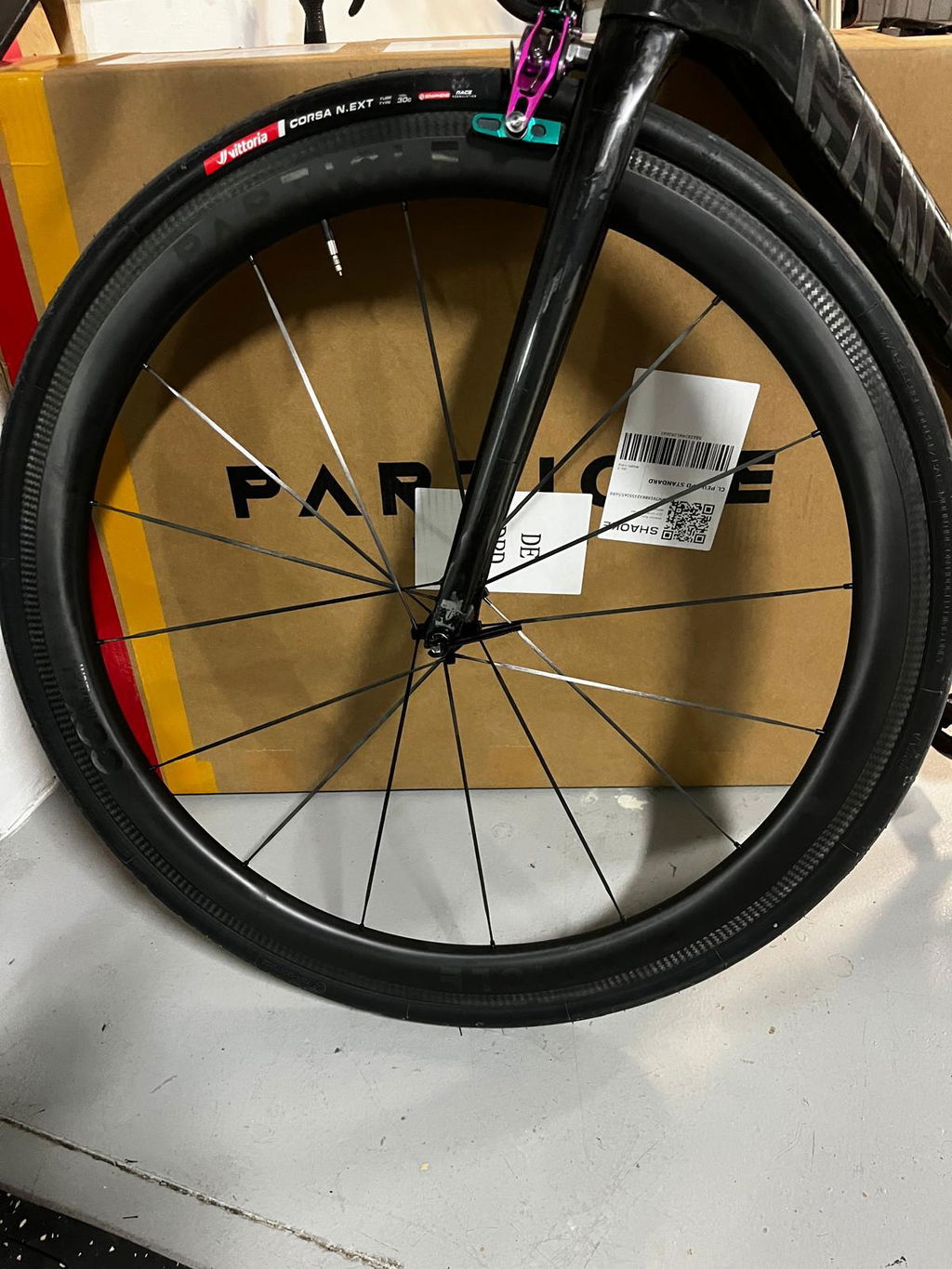
Chinese carbon wheels can be a smart buy, but only when the manufacturer, testing, and fit are all checked carefully.
Are Chinese Carbon Fiber Wheels Safe?
Carbon Wheels: Debunking the Country of Origin Myth
Chinese carbon wheels can be safe, but quality depends entirely on the manufacturer, not the country of origin.
While some brands deliver robust layups, reliable hubs, and documented testing that rival Western competitors, others cut corners on materials and inspection—introducing real structural risk.
Safety is a quantifiable engineering metric, not a geographical label. For example, all Particle wheels are engineered to survive impacts of 90+ joules, which is more than twice the 40-joule UCI Vertical Impact Test standard.
To find a truly safe option, buyers must look past the price tag and evaluate five core areas:
-
Carbon Layup Quality: Structural integrity of the rim construction.
-
Hub Reliability: Dependable hub components and performance.
-
Spoke Construction: Overall wheel build stability.
-
Testing Transparency: Documented, proven impact data.
- Warranty Support: Reliable manufacturer backing and customer care.
Carbon fiber construction basics
Carbon wheel strength comes from how the fibers are layered, how much resin is used, and how the rim is cured. Consistency is driven by material choice and finishing.
Particle uses genuine Toray carbon fiber and employs a paint-free, unidirectional raw finish to save weight. Furthermore, rims undergo a second curing process at high temperatures for extended durations to maximize durability. That is why careful manufacturing is a bigger deal than most marketing copy suggests.

Why riders consider them
Riders usually look at Chinese carbon wheels for three reasons: low weight, aerodynamic shapes, and strong value.
Compared with western brands, many buyers see a chance to get similar performance at a lower price, especially when moving up from stock alloy wheels.
Main Risks to Watch Before Buying
The biggest safety concerns are not mysterious. Poor layup, weak hubs, bad spoke assembly, and uneven quality control are the usual problems.
These are real safety risks, not just vague brand skepticism. The cheapest option is rarely the safest choice, especially if the listing offers little detail and no meaningful support.
Quality control problems
Quality control is where many low-cost wheels either prove themselves or fall apart. When factories skip testing or inspection, small defects slip through: uneven resin coverage, inconsistent spoke tension, or rims that are not perfectly round.
Those flaws may not show up on day one, but they can create problems later during braking, sprinting, or rough riding. Transparency in testing is mandatory.
Every Particle wheelset undergoes more than a dozen lab tests, including Spoke Hole Maximum Pull-Through, Dynamic Balance, and Greenhouse tests.
Final checks include ensuring lateral and radial runout are within 0.25mm before shipping.
Failure points to inspect
Rim cracks, hub failures, spoke problems, and poor brake-track performance are the main points to inspect. Damage often appears after hard riding, repeated heat cycles, or a sharp impact rather than during casual use.
Heavy riders and aggressive riders should be stricter about build quality because the wheel sees more load in corners, sprints, and rough pavement.
Rim brake users must prioritize brake-track quality, as sustained braking heat can easily expose weak resin or inadequate curing. A truly safe wheelset requires an engineered thermal margin rather than just an attractive aesthetic.
To solve this, Particle’s CCX Ultralight series features a 3K twill brake track constructed with 220°C high-temperature resin, ensuring excellent thermal resistance and structural integrity under heavy braking loads.

How to Judge Build Quality
Good wheels usually give away their quality through specifics. Weak wheels hide behind broad claims like “pro level,” “race ready,” or “premium carbon.”
Before checkout, look for clear details about materials, rim dimensions, hub type, spoke count, and testing. Transparency matters more than polished branding because it lets you compare one wheelset against another instead of guessing. If a company is serious, it will usually explain what it uses and why.
| Quality signal | What to look for | Why it matters |
|---|---|---|
| Material details | Carbon grade, layup, resin type | Shows engineering depth |
| Testing | Fatigue, impact, published results | Helps verify safety |
| Hub system | Serviceable bearings, strong engagement | Affects reliability |
| Assembly | Even tension, true rims | Supports durability |
Testing and certification
Particle proves performance through top-tier competition. The RCX Ultralight series is currently raced by UCI Continental teams and has been ridden in WorldTour races, with specific UCI approval across the Hyperlight, Ultralight, and Team series.
Hub, spokes, and assembly quality
Particle utilizes the 'gold standard' star ratchet system in its AR1 and SR1 hubs, which are machined to extreme tolerances of 0.003mm to 0.005mm.
These are paired with 4th-generation replaceable carbon spokes featuring titanium heads, weighing just 2.1g each—the lightest commercially available.
Spoke count and lacing pattern influence stiffness and strength, especially on carbon wheels with carbon spokes or low-spoke designs.
Before buying, look for even tension, a true rim, and clean finishing around the nipple bed, valve hole, and spoke interface. Good assembly is visible if you know where to look.

Overseas Carbon Wheel Brands vs Western Brands
| Factor | Chinese carbon wheels | Western brands |
|---|---|---|
| Price | Usually lower | Usually higher |
| Support | Varies by seller | Often stronger |
| Performance | Can be excellent | Often excellent |
| Consistency | Depends on brand | Usually more predictable |
Price and performance
At lower budget levels, the performance gap can be surprisingly small, especially for riders upgrading from entry-level alloy wheels.
Some Chinese wheels now match premium competitors in weight, aero shaping, and ride feel. That said, top-tier western brands still justify their premium for riders who want a proven track record, refined finishing, and shop-backed service.
The value question is not whether one side is “better” in every case, but whether the rider is paying for performance, support, or both.
Warranty and customer support
Particle offers a 3-year standard warranty with optional extended lifetime rim coverage. This is backed by a Lifetime Crash Replacement Policy providing a 25% discount on replacements for the original owner. A cheaper wheel with poor backup can become expensive quickly if downtime matters.
What to Check for Compatibility
A safe wheel is still a bad purchase if it does not fit the bike. Compatibility issues create returns, delays, and expensive mistakes.
Before ordering, confirm the brake system, axle type, freehub body, cassette fitment, tire clearance, and intended riding style.
Those details are easy to overlook when the wheel looks good on paper, but they are the difference between a smooth install and a frustrating one.
Brake and axle standards
Rim brake and disc brake wheels are not interchangeable, and axle standards must match the frame and fork. Check whether the bike uses quick release, thru-axle, or another standard.
Freehub bodies also matter: Shimano HG, SRAM XDR, and Campagnolo need different fitment. Verifying those specs before purchase prevents avoidable setup problems and shipping headaches.
Road bike, mountain bike(mtb), and e-bike fit
Rim depth, width, and strength should match the riding category. Light bicycle road wheels often prioritize lightweight and aerodynamics, while mtb bike wheels need impact resistance and lateral stiffness.
E-bike use usually calls for stronger construction and stricter load limits because torque and system weight are higher. Tire clearance and terrain matching matter too. A fast road wheel is not automatically the best choice for rough gravel or hard trail use.
How to Buy Overseas Brand's Carbon Fiber Wheels Safely
A careful buying process reduces most of the risk. Start by narrowing the field to brands that show technical details, real user feedback, and a visible history.
Then check warranty terms, support channels, and whether the product page answers basic questions before you ever reach checkout. Strong brands make the decision easier by being specific. Risky sellers rely on vague claims and low prices.
Check brand reputation
Independent reviews, rider forums, and mileage reports are more useful than polished product photos. Look for brands with a real track record, not just a storefront.
A brand that explains rim dimensions, hub options, and testing usually has more to lose from poor quality than an anonymous seller does. If there is little technical information or no service contact, move on.
Verify warranty and support
Compare warranty length, crash replacement terms, and the availability of spare parts. If a wheel needs repair later, responsive support can save money and keep the bike on the road.
Read the fine print closely, especially around impact damage, shipping responsibility, and replacement timelines. Support is part of the product, not an optional extra.
Buy from the right channel
Established brands and official stores are safer than anonymous marketplace listings. Direct factory sales can be a good option when the seller provides strong documentation, testing information, and clear service terms.
Be cautious with listings that have missing specs, unrealistic pricing, or stock photos only. A bargain is not a bargain if the wheel arrives with unanswered questions.
Who Chinese Carbon Wheels Are Best For
Chinese carbon wheels fit riders who want strong performance per dollar and are willing to do a little research. They are especially appealing to cyclists who care about lightweight, efficient aerodynamics, and modern features without paying full western-brand pricing.
Buyers who want to compare road bike, gravel, or mtb bike upgrades side by side often find the category useful. Riders who need maximum hand-holding, local service, or absolute predictability may be better served elsewhere.
Best fit riders
Value-driven road riders, performance enthusiasts, and upgrade seekers usually get the most from this market.
It also works well for cyclists who want premium features such as carbon spokes, tubeless compatibility, and high lateral stiffness without a premium badge. Informed buyers who understand the specs and the trade-offs tend to have the best experience.
Who should be cautious
Riders who need zero downtime, strong local warranty support, or a nearby shop that can handle any issue may prefer western brands.
High-impact use, frequent racing, and heavier riders also justify stricter scrutiny. In those cases, a brand with quality customer service may be the safer long-term choice.
Common Questions About Chinese Carbon Wheels
Most buying hesitation comes down to three questions: are they safe, how long do they last, and are they worth it?
The short answers are practical. Some are excellent, some are risky, and the difference is in the details. Riders who inspect the specs, testing, and support terms usually end up with a much better result than those chasing the lowest sticker price.
Q: Are cheap Chinese carbon wheels safe?
A: Cheap does not automatically mean unsafe, but it does mean the buyer should look harder. The biggest risk comes from unknown sellers with no testing, no service structure, and no visible history.
A low price is only worthwhile if the wheel still has credible construction and support behind it.
Q: How long do they last?
A: Lifespan depends more on manufacturing quality than on origin. Rider weight, road conditions, braking heat, and maintenance all affect durability.
Regular inspection for cracks, trueness, spoke tension, and hub wear helps catch problems early before they become failures.
Q: Are they worth buying over a western brand?
A: Carbon wheels are worth buying when a strong performance-to-price balance is backed by verified engineering documentation.
While Western brands traditionally held the advantage in post-purchase support, Particle bridges this gap.
Operating as a registered Hong Kong business founded by an American expatriate, Particle integrates Western customer service standards with concrete legal protections, offering riders full credit card chargeback safety and contracts enforceable in English under common law.
The ultimate buying rule is simple: if the specifications are transparent, the testing is credible, and the customer support is verifiable, the wheelset deserves your serious consideration.
Final Thoughts
Safety comes from documentation and trust, two qualities that can be hard to find with a ultra low price tag. The best purchase is the one that balances performance, proof, and peace of mind.